
African delivery compared — the Johannesburg gravity well, the majors' real footprints, subsea abundance against inland scarcity, and how to buy for audiences the brochures round off.
Winner depends on your workload.
Winner depends on: which Africa you mean. South African audiences are well served — NAPAfrica ranks among the world's top peering hubs and every major peers there; West and East African audiences live on fewer, shallower POPs (Lagos, Nairobi, Cairo hubs) where Cloudflare's breadth-first distribution and Akamai's carrier embedding lead; inland audiences still ride hundreds of milliseconds to someone's hub, and no vendor map changes that physics.
The gravity well and the long tail
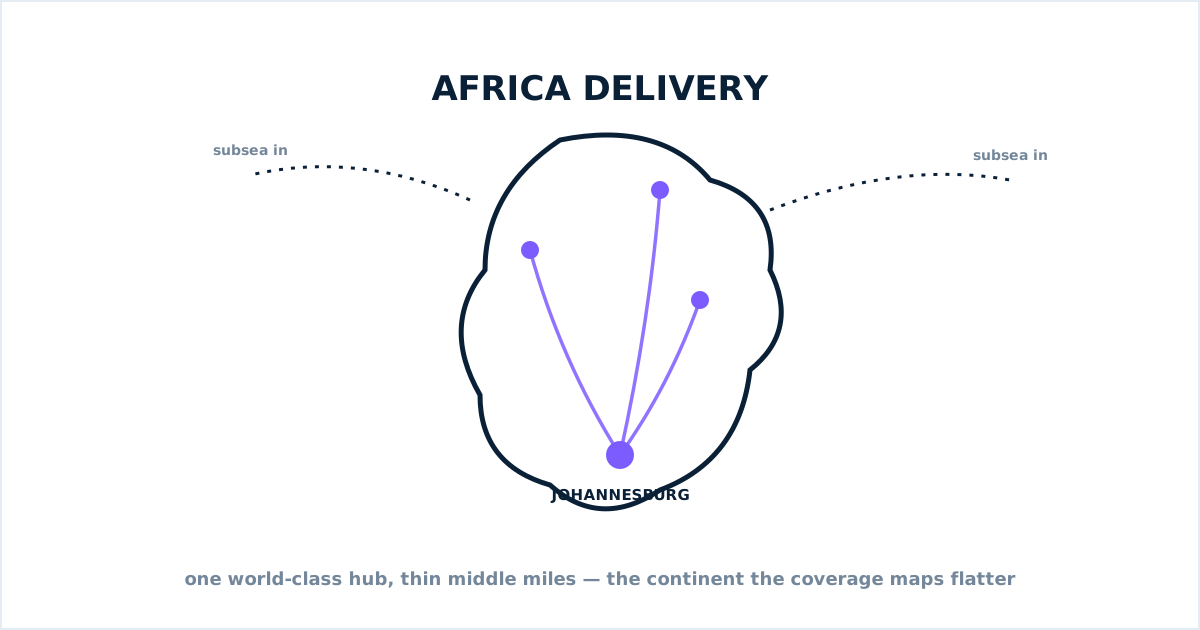
African delivery has one world-class anchor and a steep drop after it. NAPAfrica in Johannesburg ranks 12th among global internet exchanges by connected capacity — the only African IX in the top 30 — making South Africa the continent's delivery stronghold, where the majors peer densely and performance approaches European norms. The next tier is a set of hub cities — Lagos (IXPN, ranked far down the global table at ~60th), Nairobi, Cairo, Accra, Dar es Salaam — with real but thinner CDN presence. Beyond the hubs, the honest picture: audiences served from a neighboring country's POP or from Europe, with the latency to match.
| Player | African posture | Field notes |
|---|---|---|
| Cloudflare | Breadth-first: the most widely distributed peering network globally (352 IXs), with POPs across a dozen-plus African cities | The default for pan-African reach on a budget; free tier makes it the continent's de facto entry CDN |
| Akamai | Carrier-embedded servers plus hub POPs; publishes country presence but not city detail | The ISP-embedding model suits markets where the eyeball network is the bottleneck |
| CloudFront / Google / Azure | Hub POPs (Johannesburg, Cape Town, Nairobi, Lagos, Cairo vary by provider) | Fine for hub audiences; verify the specific city list against yours |
| Regional infrastructure | Liquid Intelligent Technologies, Angola Cables, Teraco (the JB data-center anchor), national carriers | The layer that decides what any CDN can achieve; partnerships here matter more than logos |
| Value tier | Spotty — often Johannesburg only, sometimes nothing | Sub-cent pricing rarely includes African POPs; delivery falls back to Europe |
Subsea abundance, inland scarcity
The last five years transformed the continent's connectivity to the world — Equiano, 2Africa and peers landed enormous subsea capacity — but the middle mile inland moved slower, so the paradox of African delivery persists: a coastal hub may have world-class international bandwidth while a city 500 km inland pays dearly to reach it. For delivery buyers this inverts the usual instinct: the constraint is rarely the CDN's POP count and usually the path from POP to eyeball network. Two diligence questions cut through every brochure: which African ISPs does the provider peer with or embed in, and what does your RUM say per-ASN — the measurement discipline from the RUM roundup matters more here than anywhere.
Buying for African audiences
Working patterns: South Africa-centric — any major performs; benchmark and buy on price. Pan-African consumer reach — Cloudflare's distribution plus Akamai's carrier embedding are the two serious defaults; measure both against your ASN mix. Mobile-first products (most of the continent's traffic) — weight your testing to mobile networks and 3G/4G realities, and let payload discipline do what POPs cannot; a 200 KB page beats a nearby edge serving 2 MB. And price honestly: several majors surcharge African delivery or serve it from EU rate rows — the regional-pricing audit belongs in the contract review, per what a CDN should cost. Facts verified against provider documentation and peering data, July 2026.
Serving 'Africa' from two POPs and a European fallback? The assessment measures your real per-ASN experience across the continent.