
Response-time SLAs, severity ladders and the price of a human — CDN support models compared, from community forums to named engineers.
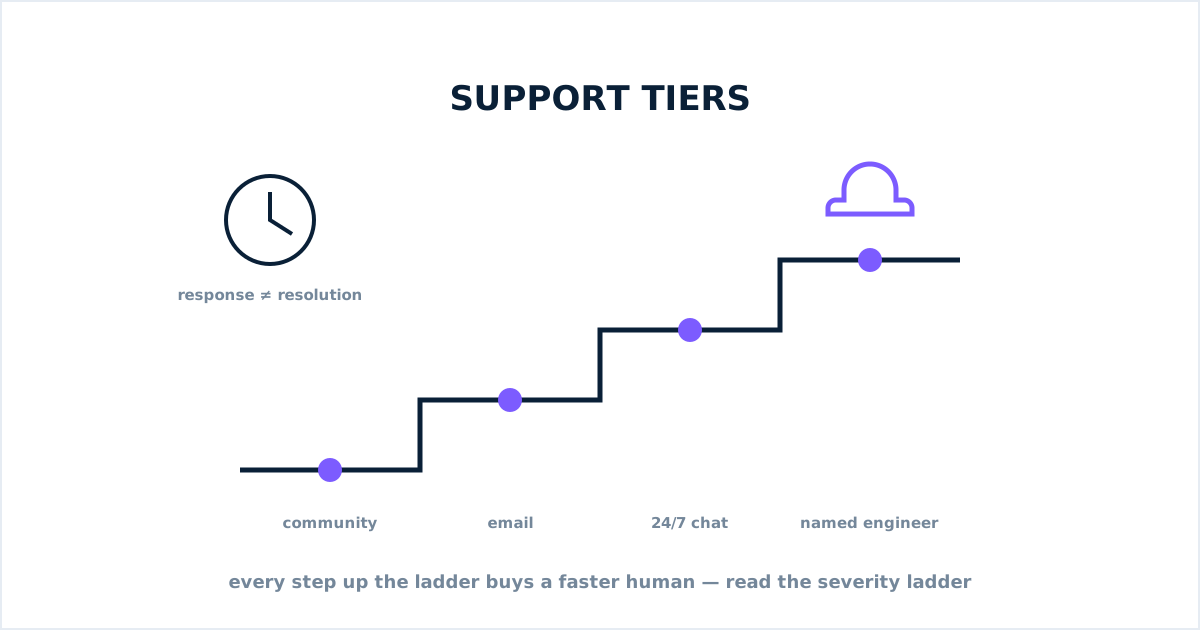
Winner depends on your workload.
Winner depends on: your tolerance for waiting during a severity-one. Enterprise contracts everywhere buy fast humans; the meaningful comparison is the middle — plan-gated support (Cloudflare), spend-scaled support (AWS), included 24/7 support at the value tier (CDN77, Bunny, Gcore) — and whether response SLAs in the contract measure response or resolution, which are very different promises.
Support is a product with a price list
Every provider delivers roughly the same ladder — community, email, chat, phone, named humans — but attaches it to your bill differently. Three billing philosophies dominate: plan-gated (support quality follows your subscription tier), spend-scaled (a percentage of your monthly bill buys the tier, the AWS model, with published minimums that start under a hundred dollars and rise to five figures for enterprise), and included (the value tier's 24/7 support at no separate line item, which the CDN77s and Bunnys of the world treat as a competitive weapon). Enterprise CDN contracts at Akamai, Fastly and Cloudflare add the fourth: negotiated support schedules with named contacts, premium tiers and professional-services attach.
| Model | Who runs it | What to check |
|---|---|---|
| Plan-gated | Cloudflare (community on Free up through prioritized channels and named contacts on Enterprise) | Which severities can even be filed at your tier, and through which channel |
| Spend-scaled | AWS (support plans priced as the greater of a floor or a percentage of monthly spend) | The percentage compounds with growth — model it at next year's bill, not this one's |
| Included 24/7 | CDN77, Bunny, Gcore, KeyCDN | Real response speed and depth — test during the trial at 3 a.m. your time |
| Contract-negotiated | Akamai, Fastly, enterprise tiers generally | Severity definitions, response SLAs per severity, escalation path, and whether premium support is bundled or a separate SKU |
Read the severity ladder, not the brochure
The number that matters in any support schedule is the severity-one response commitment — and the definition of severity one, which vendors write narrowly for good reason. Check three clauses. First, response versus resolution: a 15-minute response SLA promises a human acknowledges you in 15 minutes, not that anything gets fixed; resolution commitments are rare and precious. Second, the channel: a sev-1 that must be filed through a web form is slower than one with a phone bridge, whatever the SLA says. Third, scope: platform-wide incidents are usually carved out — precisely the moments you most want the hotline — which is why status-page history is part of support due diligence, the observability gap we keep returning to.
What support quality correlates with
From renewal work across the field, three patterns hold. Support quality tracks account size more than list tier — the schedule is a floor, and large accounts get discretionary attention above it. The value tier's included support is frequently faster than mid-tier support at the majors for simple issues, and shallower for weird ones — a fair trade for simple estates, a bad one for complex configs. And ticket friction is a real cost that belongs in TCO: an engineer-hour spent shepherding a ticket is priced exactly like an engineer-hour, a line we itemize alongside the rest in what a CDN should cost.
Negotiate it like the product it is
Support terms move in negotiations more easily than unit prices — vendors protect the rate card and flex the schedule. Worth asking for in any renewal: premium support bundled at standard-tier pricing, a named technical contact, defined escalation to engineering, and quarterly service reviews. And test the machinery before you rely on it: file a real medium-severity ticket during evaluation (the plan we set out in the trials comparison) and once a year in production. A support contract you have never exercised is a fire extinguisher you have never checked. Facts verified against provider documentation, July 2026.
Want your support schedule benchmarked against what accounts your size actually get? The assessment includes it.