
The security specialist (now under Thales) against the edge giant’s portfolio — WAF, DDoS, bots and the data layer compared.
Winner depends on your workload.
Winner depends on: whether your risk concentrates at the application-and-data layer (Imperva’s home ground, down to the database) or across delivery-scale attack surfaces (Akamai’s), and which vendor’s SLA language your compliance regime actually needs.
Side by side
| Imperva (Thales) | Akamai | |
|---|---|---|
| Identity | Security specialist; WAF + data security heritage, acquired by Thales | Edge platform with a top-tier security portfolio |
| WAF | Cloud WAF + on-prem WAF Gateway; long analyst-leader track record | App & API Protector with Adaptive Security Engine |
| DDoS | 3-second mitigation SLA (L3/4); 13 Tbps scrubbing; 99.999% uptime SLA | Prolexic dedicated scrubbing + edge-scale absorption |
| Bots / ATO | Advanced Bot Protection (ex-Distil) | Bot Manager / Account Protector |
| Beyond the edge | Database security, data risk analytics, RASP | Zero trust (Guardicore), enterprise access |
| Buying | Enterprise, from ~$400+/mo cloud tiers to custom | Enterprise-only, contract-led |
A specialist and a platform
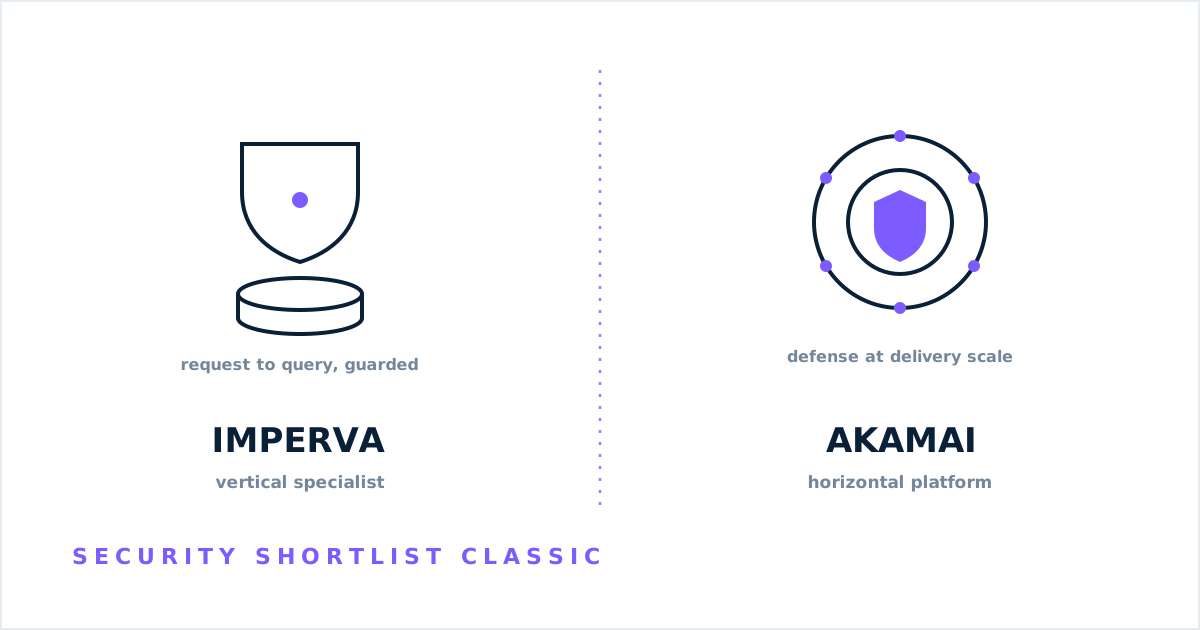
These two meet on every serious enterprise security shortlist, but they arrive from opposite directions. Imperva — now operating under Thales after its acquisition — is a security pure-play whose stack runs unusually deep vertically: cloud and on-prem WAF, DDoS, bot defense, API security, RASP, and a database-security line no CDN vendor matches. Akamai arrives horizontally: security products born from operating one of the internet’s largest delivery platforms, where scale itself is a defensive asset. The overlap — WAF, DDoS, bots — is where procurement fights happen; the non-overlap is where the decision usually hides.
The overlap, product by product
On WAF, both are long-running leaders in analyst evaluations: Imperva’s engine carries two decades of application-security specialization and ships in genuinely equivalent cloud and on-prem forms — still a differentiator for data-residency-bound estates — while Akamai’s App & API Protector brings the self-tuning Adaptive Security Engine we examined in Cloudflare WAF vs App & API Protector. On DDoS, the contrast is contractual as much as technical: Imperva’s signature commitment is a 3-second mitigation SLA for L3/4 attacks backed by roughly 13 Tbps of scrubbing capacity and a 99.999% availability SLA on its cloud services; Akamai answers with Prolexic’s dedicated scrubbing centers plus an edge platform whose sheer capacity absorbs volumetric attacks as a byproduct of existing. On bots, Imperva’s Advanced Bot Protection (built on the acquired Distil technology) and Akamai’s Bot Manager are both first-tier; adversarial-retail estates should trial both on their own login and checkout flows rather than trust anyone’s deck.
The non-overlap decides
Imperva’s unmatched territory is the data layer: database activity monitoring, data risk analytics and compliance tooling that extend protection from the request all the way to the query — which is why data-heavy, audit-heavy industries (finance, healthcare, public sector) keep it on speed dial, and why Thales bought it to sit beside its encryption and key-management lines. Akamai’s unmatched territory is the edge itself: delivery-integrated security, the Guardicore zero-trust segmentation line, and enforcement points already positioned in front of your traffic at planetary scale. Ask which layer your worst realistic incident lives in; that answer usually names your vendor.
Money and operating weight
Both sell enterprise-first, but Imperva retains reachable published entry points (cloud WAF tiers from around $400/month) beneath its custom contracts, while Akamai security is contract-led throughout — typical engagements sit comfortably in five-to-six figures annually. Operationally, Imperva’s network-DDoS onboarding is a managed, GRE-and-BGP affair with a solution manager attached; Akamai deployments ride the Property Manager discipline of the wider platform. Neither is a self-service purchase; both reward negotiation, and both discount hardest when they know you’re benchmarking. Figures checked against provider documentation, July 2026.
How to decide
Segment by risk center. Application-and-data-centric risk, compliance-driven, possibly hybrid on-prem: Imperva’s vertical depth is built for you. Delivery-scale risk — global properties, media platforms, event traffic, edge-adjacent zero trust: Akamai’s horizontal reach wins. Plenty of enterprises rightly run both — Akamai at the edge, Imperva at the data layer — and the honest procurement question is not either/or but where the seam between them should sit.
Renewing an enterprise security contract this year? The assessment benchmarks both stacks — and the seam between them — against your risk map.