
Latin American delivery compared — Azion's home-field platform, the carrier-infrastructure tier, the majors' coverage reality and the peering economics that decide Brazil vs everywhere-else.
Winner depends on your workload.
Winner depends on: whether your audience is Brazil or the rest of the continent. Brazil is a mature market — deep IX ecosystem, a genuine home-grown platform in Azion, every major present; Spanish-speaking LATAM is thinner, where carrier-infrastructure players (Cirion, EdgeUno) and the majors' hub cities carry the load. Local platform, global major, or a blend along that line is the real decision.
Two markets wearing one acronym
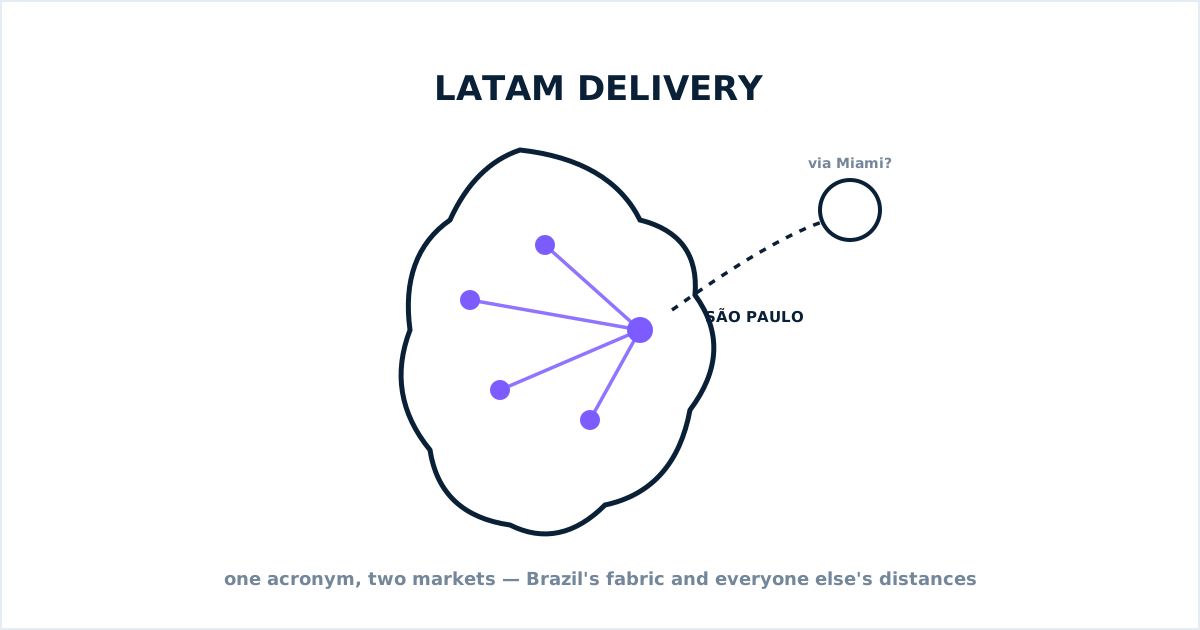
Latin American delivery splits cleanly at the Brazilian border. Brazil has the continent's dominant peering fabric (the IX.br ecosystem ranks among the world's largest), data-center depth across São Paulo, Rio and beyond, and — unusually for any region outside the US and China — a home-grown edge platform of international standing: Azion, founded in Porto Alegre in 2011, offering CDN, serverless compute and security with its deepest distribution across Brazilian cities and a compliance posture built for Brazil's LGPD and financial-sector rules. Spanish-speaking LATAM is a different market: fewer IXs, longer distances to content, and delivery that leans on hub cities — Bogotá, Santiago, Buenos Aires, Mexico City — plus the carrier tier underneath.
| Player | Shape | Field notes |
|---|---|---|
| Azion | Brazil-born full edge platform (CDN, compute, security) | The home-field pick: deepest Brazilian distribution, local legal framework, strong with LATAM financial institutions |
| Cirion Technologies | Carrier infrastructure — the former Lumen LATAM business, Stonepeak-backed | 840+ backbone PoPs, 110+ metro zones, 668 Tbps optical capacity and growing DC campuses; the pipes and rooms delivery rides on |
| EdgeUno / Zenlayer | Emerging-market infrastructure specialists | EdgeUno: ~50 LATAM data centers, ~3,000 peering relationships; Zenlayer: 180+ global PoPs with emerging-market routing focus |
| The global majors | Cloudflare, Akamai, CloudFront, Fastly et al., all present | Solid in Brazil and hub capitals; coverage thins fast outside them, and none publish per-country POP detail |
| Value tier | Bunny, Gcore, CDN77 and peers | Present in the hubs; verify actual POP cities against your audience before assuming the EU/NA experience travels |
The economics under the map
Three regional facts shape every LATAM delivery bill. Cross-border transit is expensive and often routes through Miami — the NAP of the Americas remains a de facto LATAM hub, which means Bogotá-to-Lima traffic can round-trip through Florida when local peering is absent. In-country delivery in Brazil is cheap by contrast because IX.br localizes traffic, which is why providers with dense Brazilian peering outperform their POP counts. And the majors' regional pricing reflects all of it: South American delivery typically sits on a costlier rate row than NA/EU, a divergence to price before committing traffic — the same list-versus-reality discipline as everywhere else.
Buying for the region honestly
The patterns that work: Brazil-heavy audiences — benchmark Azion against your incumbent major with real RUM; the home-field advantage is frequently real, and the platform depth (edge compute, WAF) makes it a genuine alternative rather than a regional patch. Continent-wide audiences — a global major for reach plus dense-Brazil coverage, with the value tier as price pressure. Streaming and heavy media — test hub-city throughput at peak, not off-peak; the constraint is usually capacity at the interconnect, not the POP's existence. And for anything mission-critical, the multi-CDN logic of the estate guide applies with extra force where single-provider coverage is thinnest. Facts verified against provider documentation and peering data, July 2026.
Serving São Paulo well but losing Lima and Bogotá? The assessment maps your LATAM audience against real coverage, not brochure maps.