
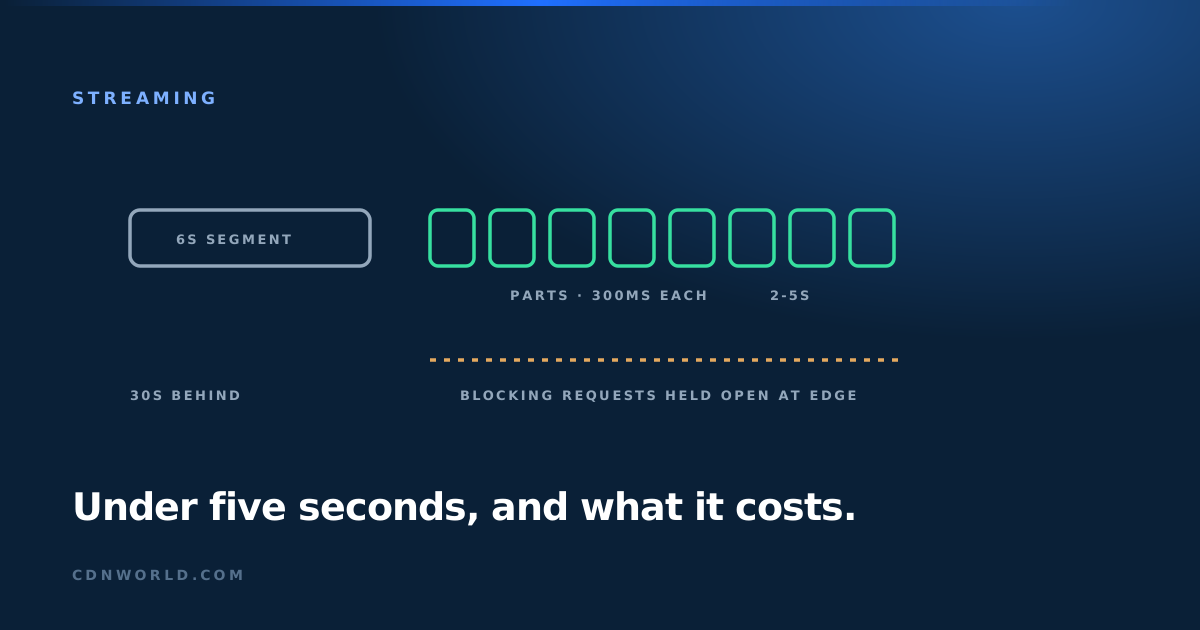
Standard HLS latency is a segment-duration tax: players buffer whole segments, so six-second segments mean tens of seconds behind live. LL-HLS restructures the contract, parts, blocking requests, preload hints, and shifts real requirements onto the delivery layer.
The mechanics of getting low
LL-HLS splits segments into partial segments (parts) of a few hundred milliseconds, advertises them in rapidly-updating playlists, and lets players request the part that does not exist yet: the server holds the request open (blocking playlist/part requests) and responds the instant the part is ready. Add preload hints so players ask early, and delivery over HTTP/2 or H3 so the request flood multiplexes cleanly, and glass-to-glass drops to the two-to-five-second band.
What it demands from the edge
This is no longer static-file delivery. The edge must hold blocking requests open and release them on origin publish (long-poll semantics at CDN scale), propagate parts with sub-second freshness, coalesce the per-part request storms, and do it across thousands of concurrent streams. Provider support is genuinely uneven: LL-HLS on the datasheet ranges from full blocking-request semantics to mere short-TTL tolerance, and the difference is your rebuffer rate at peak. Interrogate specifically: blocking support, part-level coalescing, playlist delta updates.
Perspective on the latency ladder keeps requirements honest: standard HLS sits at tens of seconds, LL-HLS lands two to five, and WebRTC lives under one second at the cost of an entirely different (and less cacheable, more expensive) delivery architecture. Most low-latency requirements, when interrogated, are actually LL-HLS-shaped: viewers care about not being spoiled by the neighbor’s cheer, not about sub-second interactivity. Reserving WebRTC economics for genuinely conversational use cases, and letting cacheable LL-HLS carry the broadcast tier, is the architecture that spends money where the product can feel it, which is the entire discipline of streaming infrastructure in one sentence.
The cost shape
Parts multiply request counts by roughly segment-duration over part-duration, an order of magnitude, so request-priced delivery gets expensive precisely as latency improves; per-GB models feel it less. Playlist traffic grows similarly. Model the request math before promising latency SLAs to the business, and revisit our per-request pricing article with LL-HLS numbers in hand.
In practice
Adopt low latency where the product genuinely needs it, sports, betting, auctions, interaction, and keep standard latency elsewhere; running both profiles from one CMAF pipeline is routine. Trial candidate CDNs with a real LL-HLS origin under synthetic concurrency, measuring part delivery times at p95 and behavior when origin publish jitters. The demo stream always works; the question is whether ten thousand of it does.
We benchmark LL-HLS support empirically per provider, blocking semantics included. Ask for the low-latency matrix.