
Gulf delivery compared — the majors' in-region POPs, the sovereign carrier tier (stc, e&), Israel's separate fabric, Türkiye's specialists and the compliance layer that decides shortlists.
Winner depends on your workload.
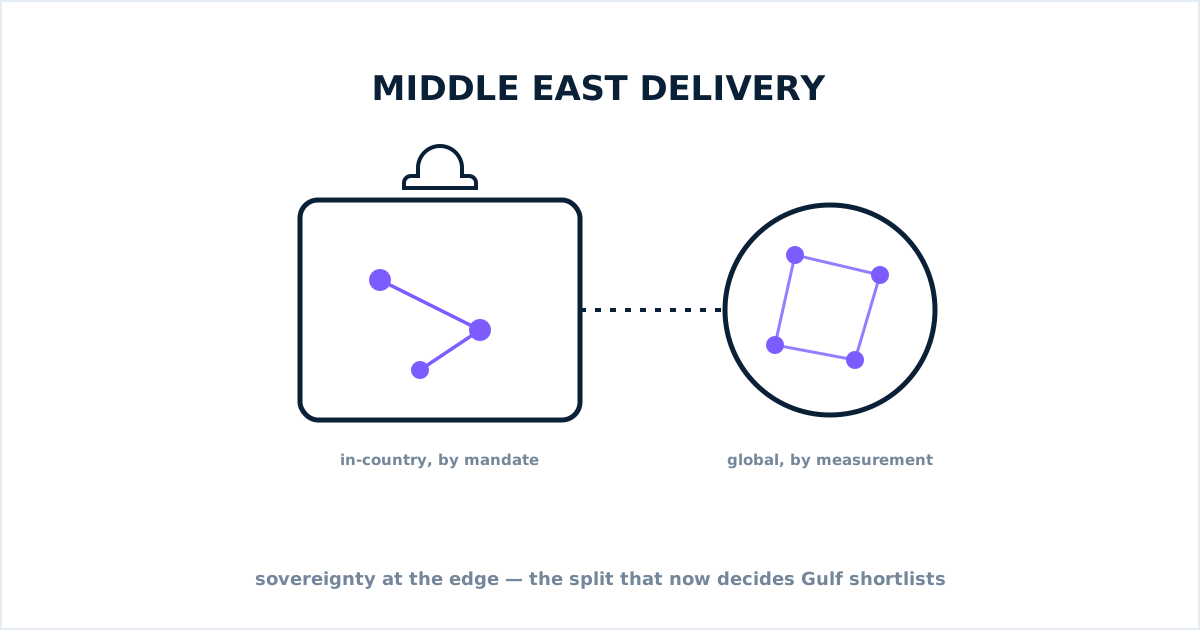
Winner depends on: how sovereign the workload is. Global majors (nineteen CDNs now run edges in the region, concentrated in UAE, Saudi Arabia and Israel) serve international-facing traffic well; regulated and government-adjacent workloads increasingly shortlist the carrier tier — stc's cloud in Saudi Arabia, e& in the UAE — for in-country routing and compliance; and routing quality varies by ISP enough that per-network measurement, not POP counting, should decide.
A region the CDN map finally reached
The Gulf spent the CDN era's first decade served from Europe — Cloudflare's own history notes its early MENA traffic rode London, Frankfurt and Marseille at 200 ms and worse before its first wave of regional POPs (Doha, Dubai, Kuwait City, Muscat). That era is over: nineteen content delivery networks now operate edges in the Middle East, concentrated in the UAE, Saudi Arabia and Israel, and no major is absent. The open questions moved up the stack: routing quality across the region's ISPs (peak-hour paths still vary sharply by network), and the sovereignty layer — where data may sit, and whose network it may cross.
| Player | Regional posture | Field notes |
|---|---|---|
| The global majors | All present; UAE and Saudi POPs standard, Israel served on its own fabric | Strong for international-facing traffic; measure per-ISP — regional routing quirks can erase POP proximity at peak |
| Sovereign carrier tier | stc (Saudi Arabia), e& (UAE) — cloud and delivery on the national carrier's own backbone | The compliance pick: in-country routing, local data handling, carrier-grade last mile; the trade is platform breadth |
| Security specialists | Radware runs dedicated regional scrubbing (UAE, Saudi) | Relevant where the requirement is DDoS-first with regional data residency |
| Türkiye's own field | Medianova and peers, Istanbul-anchored | A distinct market with a genuine local CDN industry bridging Europe and the Gulf |
| Iran's separate world | ArvanCloud and domestic platforms | Sanctions and national-network policy make it a market unto itself; plan it separately or not at all |
Compliance is the shortlist filter
Gulf procurement increasingly starts where European procurement ended up: data residency and sectoral rules first, performance second. Saudi Arabia's data regime and cloud frameworks, UAE sectoral rules, and government-adjacent contract requirements routinely mandate in-country processing — which is precisely the demand the carrier tier exists to answer, and why stc and e& keep appearing in shortlists that would have been all-Akamai a decade ago. For international vendors the answering move is local zones and regional data commitments; for buyers the diligence is the same as our China analysis in the China options piece, in milder form: who holds the local license and infrastructure, and what happens to your traffic if that arrangement changes.
Buying for the region
Patterns that hold: consumer and media traffic — a global major measured per-ISP across Saudi, UAE, Qatar and Egypt networks; the variance between ISPs within one country routinely exceeds the variance between CDNs. Regulated workloads — pair a sovereign-tier platform for in-scope data with a major for global delivery, cleanly split at the architecture level. Streaming events (the region's signature workload, from football to esports) — capacity commitments at peak matter more than average latency; ask the burst question explicitly, per the live-event logic of the video field. Facts verified against provider documentation, July 2026.
Balancing a sovereignty mandate against a global platform — or just losing Riyadh at peak? The assessment measures and maps both.