
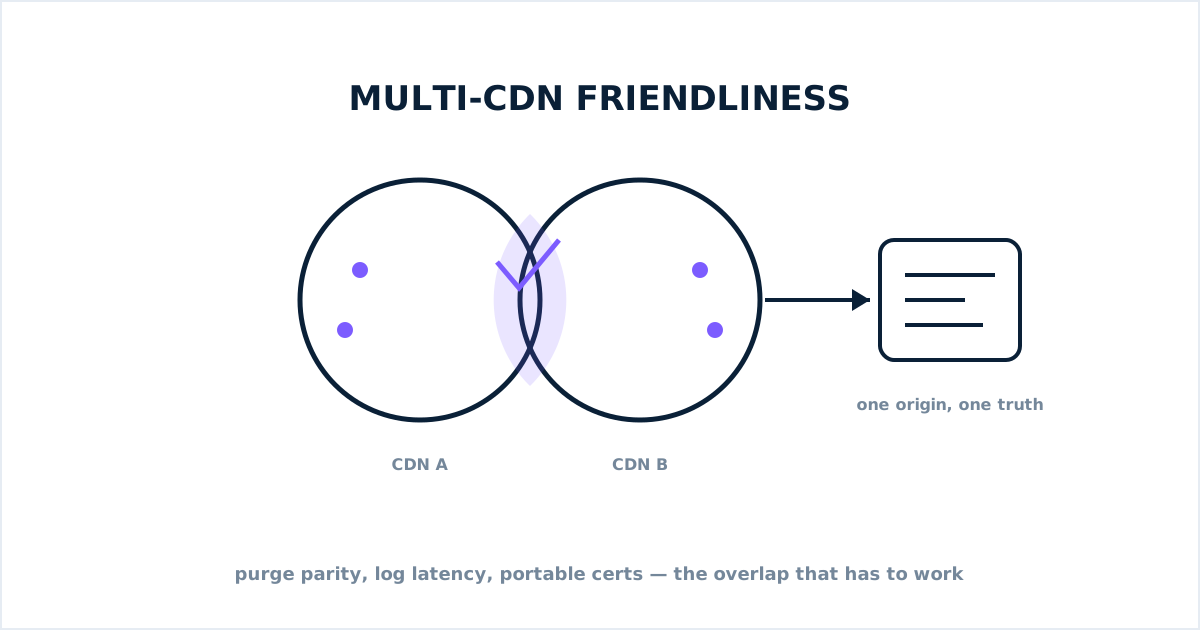
The traits that make a CDN a good citizen in a multi-vendor estate — purge parity, log latency, TLS portability, CNAME flexibility and contract shape — scored across the field.
Winner depends on your workload.
Winner depends on: which seam hurts most in your estate. Fastly's instant purge and real-time logs make it the easiest second CDN to operate; the value tier (Bunny, CDN77, Gcore, KeyCDN) is friendliest on contract shape; CloudFront and Akamai cooperate fine but pull you toward their ecosystems; Cloudflare is excellent alone and the most opinionated in company.
Friendliness is a checklist, not a vibe
Running two or more CDNs in front of one origin turns vendor quirks into operational debt: every purge must land everywhere, every log must join a common picture, every certificate must exist in every control plane, and traffic must be movable on your schedule, not the contract's. Those are testable properties. Below is how we score them when designing mixed estates — the architecture itself is covered in the multi-CDN guide.
| Trait | What good looks like | Field notes |
|---|---|---|
| Purge parity | Fast, API-driven, tag-capable invalidation on every member | Fastly's near-instant purge sets the ceiling; slower members define your real content-freshness SLA, and versioned URLs sidestep the whole seam |
| Log latency & format | Streaming delivery to your bucket/SIEM in minutes, documented schemas | Real-time streaming (Fastly, and configurable pipelines on most majors) beats periodic batch drops; unification work is on you either way |
| TLS portability | Bring-your-own certificates or per-vendor issuance for the same hostname without conflict | All majors support BYO cert at some tier; the trap is a vendor-locked cert or a hostname validation scheme that fights the other CDN's |
| Hostname flexibility | Plain CNAME targets, no forced nameserver takeover | Steering needs a DNS layer you control; a CDN that wants to BE your DNS complicates member status — the trade we mapped in DNS steering vs client switching |
| Contract shape | No minimum commit, or commits sized to a partial traffic share | Pay-as-you-go value CDNs cost nothing to keep warm as a failover member; enterprise commits price you for traffic the steering layer may never send |
| Config portability | Behavior expressible in standard headers and simple rules on both members | The more logic lives in one vendor's proprietary layer (VCL, Workers, Property Manager), the more every failover is a partial rewrite |
The standouts, honestly
Fastly earns its reputation as the second CDN of choice on operations alone: purge in moments, logs in seconds, shield POPs that can front a shared origin for the whole estate. The value tier — Bunny, CDN77, Gcore, KeyCDN — wins the commercial half: keeping a warm standby member costs pocket money, which changes failover economics entirely. Akamai and CloudFront are competent members with gravity problems: both cooperate with external steering, but their pricing and tooling reward consolidation, and CloudFront's economics tilt hard when the origin is AWS. Cloudflare deserves the nuanced sentence: peerless as a sole platform, but its bundled model — proxy, DNS, security and compute as one fabric — means using it as a partial member forfeits much of what you pay for, and moving traffic away mid-incident is easiest when Cloudflare is not also your DNS.
The seams that actually cut
Three failure patterns recur in mixed estates. Cache fragmentation: each member keeps its own cache, so adding a CDN halves the hit ratio on shared long-tail content until a common shield fixes it. Config drift: the WAF rule updated on member A and forgotten on member B — the parity problem that motivates keeping security logic at one layer. And log blindness during the exact incident multi-CDN exists for: when you shift traffic, your observability must shift with it, which is why log unification (covered here) is a day-one requirement, not a phase two.
How to buy for it
Put friendliness in the RFP as tests, not questions: time a purge to global effect on a trial zone; measure log arrival latency to your bucket; stand up the same hostname's cert on both control planes; and read the commit clause asking "what does this cost me at 20% traffic share?" A CDN that scores well on those four is a good citizen whatever its logo. Facts verified against provider documentation, July 2026.
Designing a second-CDN shortlist — or auditing whether your current pair actually fails over? The assessment scores your members on these exact seams.