
A CDN in front of your origin hides the origin's address — but hiding is not access control. Anyone who discovers the real IP, and they often can, connects straight to it and bypasses every edge protection you paid for: the WAF, the rate limits, the bot rules. Mutual TLS closes that door by making the origin refuse any connection that cannot prove it is your CDN. This guide is how to deploy it without locking yourself out in the process.
Why a hidden origin is not a protected origin
The standard CDN setup routes visitors to the edge and keeps the origin's IP address out of DNS. That raises the bar — but it is obscurity, not security. Origin IPs leak constantly: through certificate transparency logs, historical DNS records, misconfigured subdomains, email headers, and mass-scanning services that fingerprint origins behind CDNs for a living. Once an attacker has the address, they connect directly and everything you enforce at the edge simply does not apply. The WAF never sees the request; the rate limiter never counts it; the bot rules never fire.
Common half-measures help a little and fail in the end. Allowlisting the CDN's published IP ranges at your firewall breaks every time the provider adds ranges, and those ranges are shared with every other customer on that CDN — so “from the CDN” is not the same as “from my CDN account.” What you actually want is cryptographic proof that the connection came through your edge, and nothing else. That is what mutual TLS provides.
What mutual TLS actually changes
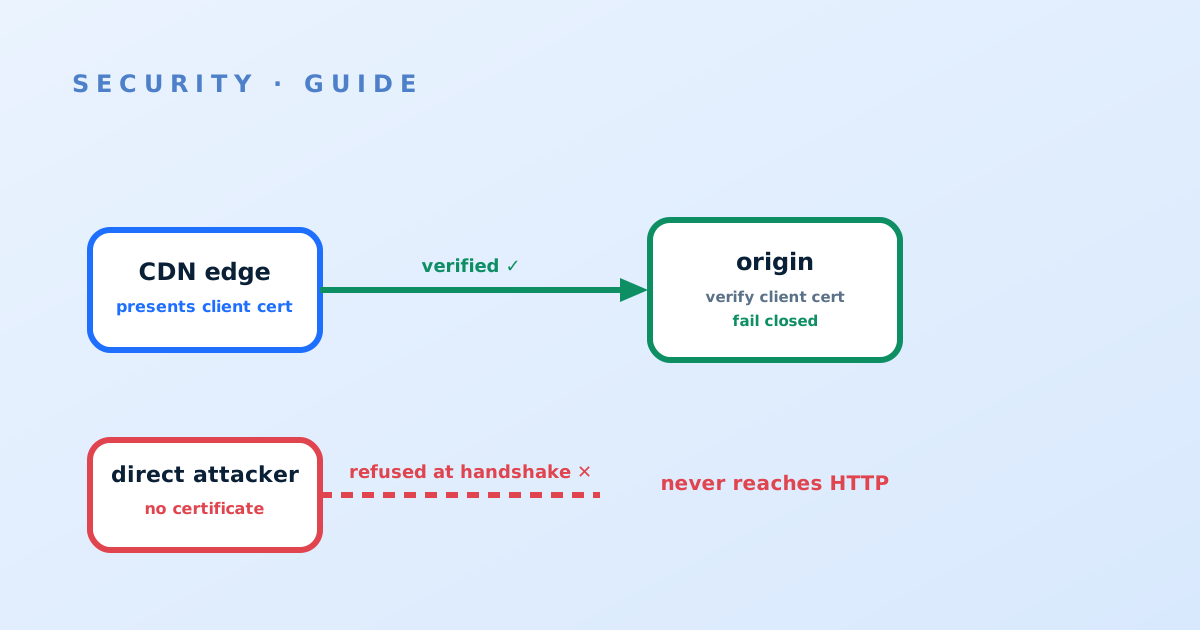
Ordinary TLS authenticates one direction: the client verifies the server's certificate. Mutual TLS adds the reverse leg — the server also demands and verifies a certificate from the client. In the CDN case, your edge presents a client certificate on the edge-to-origin connection, and your origin is configured to reject any TLS handshake that does not present a certificate it trusts. A direct attacker with no certificate never completes the handshake; the connection dies before a single HTTP byte is exchanged.
The result is a clean binary: traffic that came through your CDN is accepted, everything else is refused at the TLS layer. It is far stronger than IP allowlisting because it cannot be spoofed by knowing an address range, and it does not break when the provider renumbers. It also protects the origin from generic internet background noise — scanners and opportunistic exploits never get past the handshake.
Getting the client certificate from your CDN
Every serious CDN that supports authenticated origin pull will either issue you a client certificate to install at your origin, or let you upload your own. The provider-issued path is simplest: the CDN gives you a certificate (or a CA certificate) that its edge will present on origin connections, and you configure the origin to trust exactly that. The bring-your-own path gives you tighter control — you mint the client certificate from your own CA and hand the CDN the cert to present — and is worth it if you want the trust anchor to be yours rather than the provider's.
Whichever you choose, the principle is the same: the origin should trust only that specific certificate or CA, not the public web PKI. This is a private trust relationship between your edge and your origin; a publicly trusted certificate authority has no place in it. Scope the trust as narrowly as the provider allows.
Enforcing it at the origin
At the origin server, enforcement is a handful of directives on the TLS listener: require a client certificate, point the verifier at the CA or certificate you trust, and reject the connection on any failure. On common reverse proxies this is ssl_verify_client on with an ssl_client_certificate trust anchor, or the equivalent; the exact syntax depends on your server, but the shape is identical everywhere — demand a cert, verify it against one trusted anchor, fail closed.
Two details matter. Enforce mTLS on the origin's real listening interface, not just a hostname, so an attacker cannot reach a second virtual host that skips the check. And make sure the check fails closed — a misconfiguration that silently accepts uncertificated connections gives you the false comfort of a lock that is not latched. Test from outside your CDN and confirm the connection is refused.
Rolling it out without a lockout
The one real risk is locking yourself — or your monitoring, or your health checks — out along with the attackers. Roll it out in stages. Start with the origin requesting but not requiring the certificate, and log which connections present a valid one; confirm your CDN's traffic is passing the check before you flip to hard enforcement. Keep a break-glass path you control — a separately firewalled management interface, or a documented way to disable enforcement quickly — so a certificate expiry does not become an outage.
And treat the client certificate like the credential it is: track its expiry the way you now have to track everything else in the shortening-certificate era, and automate its renewal. An origin that fails closed is exactly what you want against attackers and exactly what you do not want against your own expired cert. Once it is live, verify the whole chain the way you would any change — confirm the edge still reaches the origin, and that a direct connection from anywhere else is refused. Pair this with a broader CDN security baseline.