
For most of the last decade, data sovereignty was a legal team’s problem and a procurement checkbox. In 2026 it has become an architecture constraint that lands squarely on delivery, because a CDN is by design the part of your stack that copies data into as many jurisdictions as possible. The distinction that matters — and that most vendor answers blur — is between where data sits and who can compel access to it.
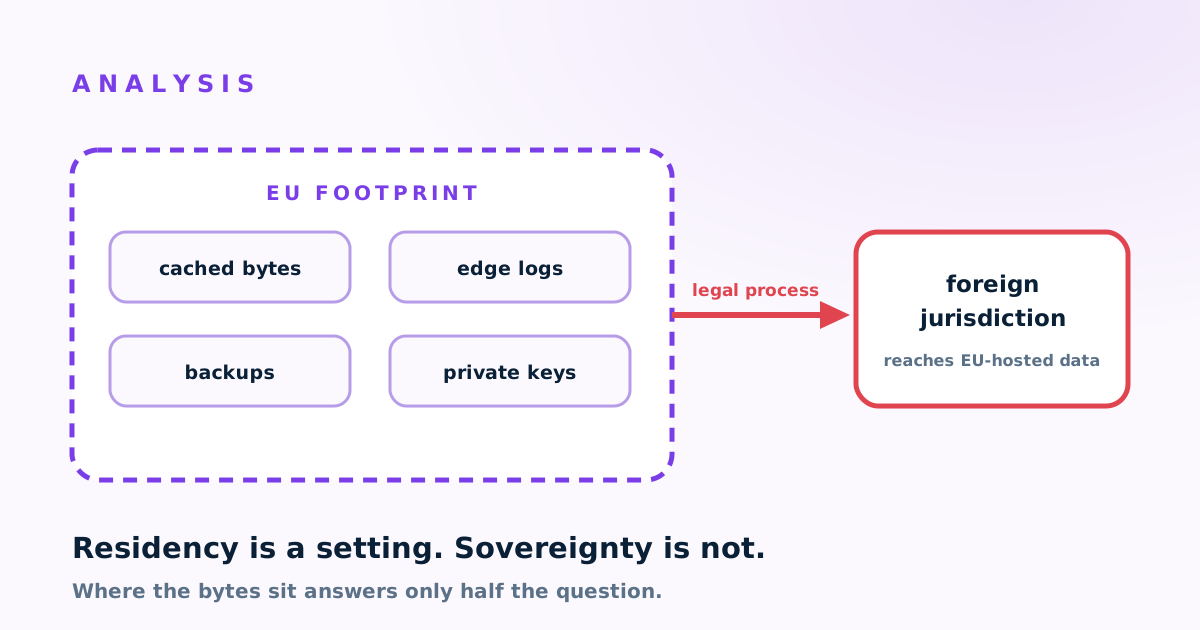
Residency is a configuration. Sovereignty is a jurisdiction.
Pinning cache and storage to EU locations satisfies residency and does nothing about jurisdiction: a US-headquartered provider operating a Frankfurt facility remains subject to US legal process. European procurement has stopped accepting the conflation, and the frameworks arriving in 2026 measure the difference explicitly. Delivery teams now need answers about keys, personnel and legal control, not just region settings.
Three layers that get called one thing
Precision here is worth the paragraph, because most disagreements about sovereignty are actually definitional. Data residency is geography: where bytes are stored, replicated and backed up. It is the easiest layer, and for a CDN it is a configuration — region pinning, restricted cache footprints, controlled storage replication.
Data sovereignty is jurisdiction: which legal system governs the data and who can lawfully compel its disclosure. This is where residency stops helping. A provider headquartered in one country and operating facilities in another is generally subject to the legal process of its home country regardless of where the servers sit, a structural conflict between legal systems that no contract clause resolves and no data centre location changes.
Operational sovereignty is the third layer: who can technically access the systems, from where, under whose employment, and with what audit trail. It covers support staff able to reach production, key custody, and whether the customer can prove — not merely be assured — that access did not occur. European regulators and procurement functions have moved decisively toward asking about this layer, which is precisely the layer most delivery vendors are least prepared to discuss.
Why 2026 is the year it reached delivery
Two things changed. First, the frameworks got specific. The European Commission’s Cloud Sovereignty Framework translates sovereignty into measurable procurement criteria across eight objectives, with graded assurance levels running from no demonstrated sovereignty up to a full European supply chain, and a minimum level required to be eligible at all. That framework was used in a real tender awarding multi-year sovereign cloud contracts across several consortia in April 2026, which converted an abstract debate into a scoring rubric with money attached.
Second, the legislative pipeline arrived. The Cloud and AI Development Act proposed in June 2026 establishes an EU-wide framework of assurance levels with audits attached, currently aimed at public-sector workloads but with the usual gravitational effect on anyone selling to them. It is a proposal rather than law, with adoption targeted for a later cycle, but procurement teams have already begun writing requirements against its shape rather than waiting.
The spending follows. Analyst forecasts put sovereign cloud infrastructure spending in the tens of billions for 2026 with growth rates in the mid-thirties percent, and a large majority of European organisations now name sovereignty as a vendor-selection criterion. When that many buyers ask the same question, it stops being a legal footnote and becomes a product requirement.
The uncomfortable part for CDNs
A content delivery network exists to replicate data close to users, which is the exact behaviour a residency requirement restricts. Every default in the architecture — cache anywhere, route anywhere, fail over anywhere — is in tension with a constraint that says these bytes may not leave this territory. Most platforms can be configured to respect a geographic boundary, but the configuration is not the default and the failure mode is silent: a failover during an incident routes traffic to a region policy forbids, and nothing alerts anyone.
Logs are the underestimated exposure. Request logs contain addresses, user agents, referrers and often identifiers, and they are frequently aggregated to a central platform in another jurisdiction as a matter of course. A carefully region-pinned delivery configuration whose telemetry ships to a different continent has satisfied the visible requirement and failed the actual one. Anyone tightening residency should audit the log path with the same seriousness as the cache path — start from what a log line contains and follow it to every destination.
Keys are the third exposure, and the sharpest. If the provider holds the private keys that terminate TLS, the provider can, under sufficient legal compulsion, be required to act. Bring-your-own-key and hold-your-own-key arrangements exist precisely to break that dependency, and their availability — not their marketing — is a reasonable proxy for how seriously a vendor takes the operational layer. The same logic pushes toward customer-controlled certificates rather than shared platform certificates, a distinction covered in handling certificates on a CDN.
What this does to vendor selection
It creates a category that did not previously compete on this axis. EU-headquartered and EU-owned providers can answer the jurisdictional question in a way that a US-headquartered provider structurally cannot, whatever its regional footprint — one of several reasons teams read Cloudflare alternatives in 2026. That is not a performance argument or a price argument, and it does not make those providers better at delivery — it makes them eligible for a specific class of workload that the incumbents are not.
It also splits estates. The realistic pattern is not wholesale migration but classification: the regulated minority of traffic moves to infrastructure that satisfies the jurisdictional test, while everything else stays where it performs best. That is a multi-provider architecture driven by legal boundaries rather than by resilience, and it needs the same discipline — consistent configuration, tested failover, and steering that will not route sovereign traffic across a boundary when something breaks. The mechanics are in designing a multi-CDN architecture.
And it reframes the incumbents’ footprint advantage. Very large distributed networks are well positioned to serve in-country requirements simply because they are already in more countries, which is why several have started describing sovereignty as a demand driver rather than a compliance burden. Reach helps with residency. It does not, on its own, answer jurisdiction.
What to actually do
Classify first. Most estates have a small proportion of genuinely sovereignty-constrained data and a large proportion that is merely assumed to be. Sorting traffic into constrained and unconstrained is unglamorous and removes most of the problem, because the constrained set is usually small enough to handle deliberately.
Then ask vendors the three questions that separate posture from capability: where do bytes rest and traverse, including logs and backups; who holds the keys and can the customer hold them instead; and which legal entity operates the service, staffed by whom, subject to which law. Get the answers in writing, because they belong in the contract rather than in a sales deck — the clause discipline in reading a CDN contract applies directly.
Then verify continuously. Region pinning that nobody tests will drift, failover will eventually route somewhere it should not, and a new subprocessor will appear in a service you already approved. Sovereignty is not a configuration you complete; it is a property you monitor, and in 2026 it belongs on the delivery team’s dashboard rather than in legal’s filing cabinet.