
What happened to ChinaCache is a short story with a long moral. China’s first CDN, founded in 1998, was delisted from Nasdaq in 2019 after its chief executive resigned amid a criminal investigation; by February 2023 its international business had been sold and the brand had stopped being a company you could buy from. The moral is not one vendor’s governance. It is that in a licensed market your delivery rests on a permit you do not hold and cannot port.
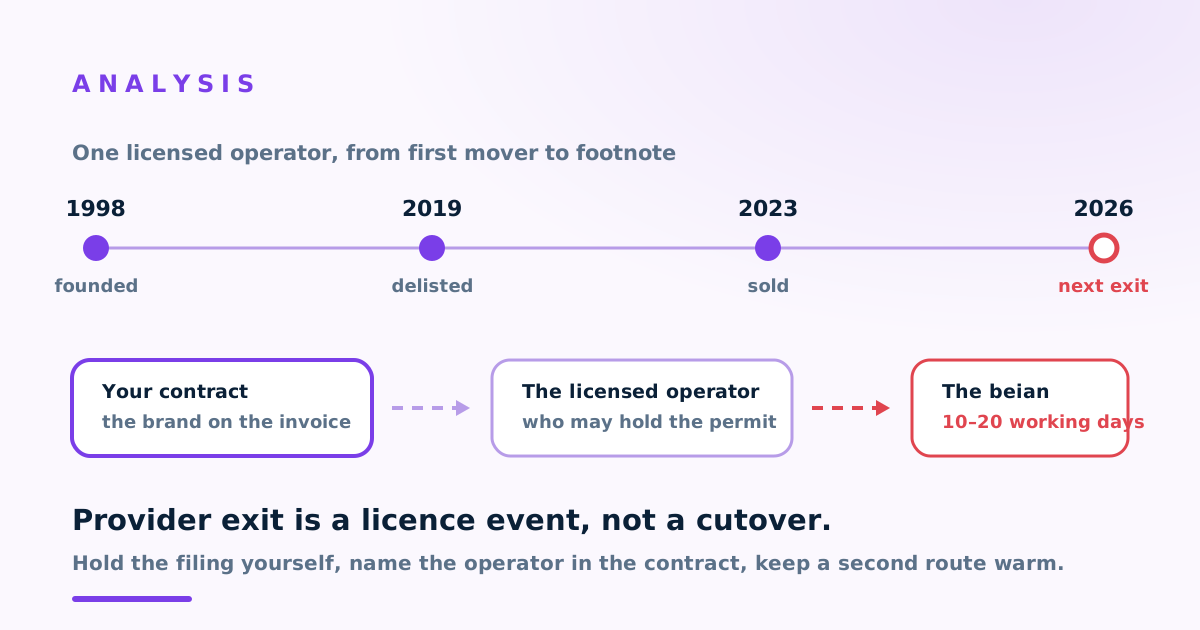
Provider exit is a licence event.
Everywhere else, changing CDN is a configuration change you can rehearse. Inside mainland China it is a filing change with an approval queue, and the queue does not care that your traffic is already broken. Underwrite the exit before you sign, not when the notice arrives.
What actually happened
ChinaCache was the pioneer: the first Chinese CDN to go global, listed on Nasdaq as CCIH. The unwinding was quick. A delayed annual report in 2019 was followed by the disclosure that the company and its chief executive were under investigation by Beijing authorities over enterprise bribery; he resigned, trading was halted, and that September the Nasdaq hearings panel delisted the shares, unappealed. In February 2023 EdgeNext acquired the international CDN operations, folding them into a platform founded only the year before and taking its footprint past 1,700 points of presence. Our ChinaCache profile tracks what remains; the successor is profiled as EdgeNext.
Why a CDN exit in China is not a migration
Outside China, losing a provider costs a cutover: re-point DNS, warm the cache, watch the hit ratio recover. Inside the mainland, delivery is gated by the ICP filing — the beian — which ties a domain to an approved operator and a mainland legal entity. Change the operator and the filing must be updated: an administrative queue, not an API call. Practitioner guidance puts a standard filing at two to four weeks, provincial approval alone commonly ten to twenty working days, plus a public security filing due within thirty days of the number being issued.
Read that against an outage. If your licensed provider stops serving you, the fallback is not a competitor’s edge — it cannot legally carry your domain until the paperwork clears — but delivery from outside the mainland, with the latency and loss that implies.
Akamai’s version, with a date attached
The same lesson now runs to a published deadline. Akamai is ending its own mainland CDN, with all China CDN services decommissioned on 30 June 2026 and delivery continuing through partnerships with Tencent Cloud and Wangsu, where Akamai resells its partners’ mainland services. Customers who act move to a partner solution; customers who do nothing are served from neighbouring countries. That default is the honest picture of an exit: still reachable, measurably slower, no longer inside the perimeter you bought.
What to underwrite before you sign
Four terms decide how survivable an exit is. Hold the beian in your own mainland entity’s name, so the filing follows you. Name the licensed operator in the contract: the brand on the invoice and the holder of the permit are often different companies. Fix a notice period long enough to cover a re-filing — months, not the thirty days a global master agreement tends to offer. And keep configuration and logs exportable, since an edge you cannot reproduce is an edge you cannot leave quickly.
Then keep a second route usable rather than theoretical: a near-China edge, or a second licensed operator already filed for your domain, with DNS TTLs short enough to steer in minutes. The architectures are laid out in delivering into mainland China and compared in the options, compared.
The verdict
ChinaCache did not fail because Chinese delivery is unusually fragile; it failed for reasons any company can fail for. What made it instructive is that its customers could not treat the failure as a procurement problem to solve in a fortnight. Two exits in seven years, one disorderly and one scheduled, are enough to stop pricing this risk at zero. The shape repeats wherever a regulator stands between you and your audience, as it does for delivery into Russia and the CIS. Ask the exit question during selection and put the answer in the contract: what you are buying here is access to a licence, and licences change hands.