
NS1 Connect, Route 53, Cloudflare DNS, Akamai GTM and NetScaler ITM as multi-CDN steering layers — data inputs, decision logic, blast radius and the independence question.
Winner depends on your workload.
Winner depends on: how smart you need the answer to be. IBM NS1 Connect's Filter Chains with Pulsar RUM are the most expressive purpose-built steering; Route 53's routing policies cover weighted/latency/failover solidly inside AWS; NetScaler ITM carries the Cedexis RUM lineage; Akamai GTM suits Akamai-anchored estates; Cloudflare DNS is superb DNS that steers best toward Cloudflare. Independence from your CDN vendors is the one property to refuse to trade.
The layer above the CDNs
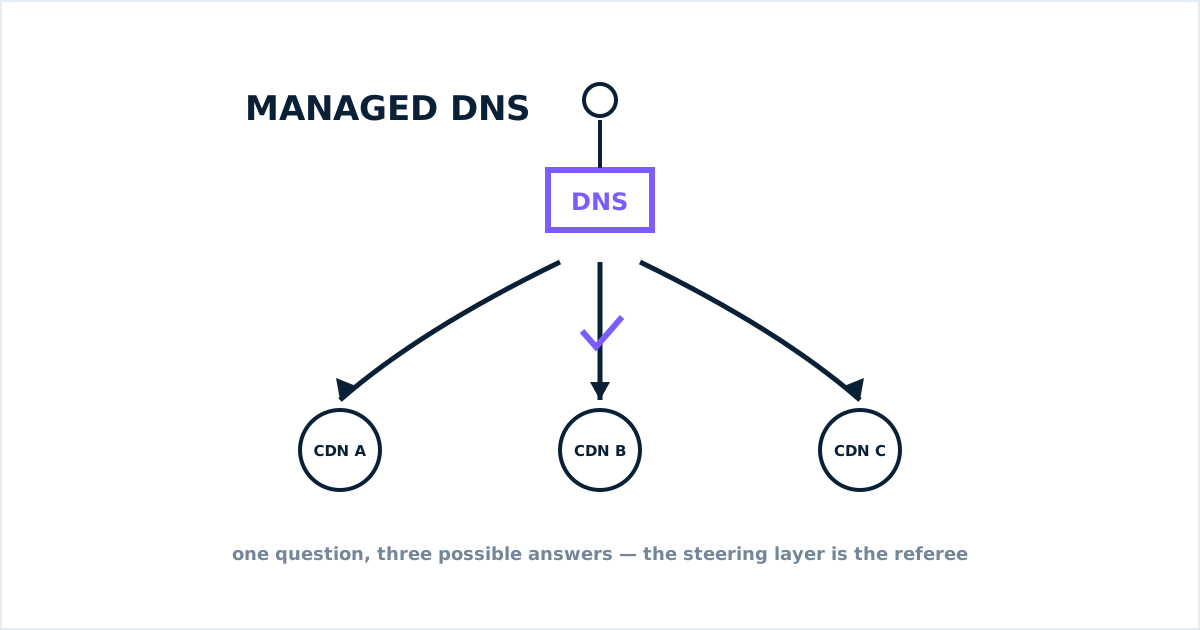
In a multi-CDN estate, DNS is where the decision lives: a resolver asks for your hostname, and the answer — this CDN's edge, not that one's — is the steering act. That makes the DNS provider's decision machinery the real product: what data can inform the answer (health checks, latency, real-user measurements, cost counters), how expressive the logic can be, and how fast a change propagates against the TTL physics we covered in DNS steering vs client switching.
| Provider | Steering machinery | Notes |
|---|---|---|
| IBM NS1 Connect | Filter Chains — sequential filters (up, geo, ASN, shuffle, shed-load, RUM-driven) refining answers per query; Pulsar ingests real-user measurements including aggregated benchmarks across 20+ public CDNs | Purpose-built for this job; 26-PoP anycast network, API/Terraform-first; the shed-load filter manages CDN commit limits automatically |
| Amazon Route 53 | Routing policies: weighted, latency-based, geolocation, failover, plus health checks and traffic-flow policy trees | Rock-solid and cheap; expressiveness caps below filter-chain logic, and the console gravity is AWS-shaped |
| NetScaler ITM (ex-Cedexis) | RUM-community-driven global load balancing — the Radar measurement lineage under Cloud Software Group | The original crowd-measured steering; verify roadmap vitality as part of diligence |
| Akamai GTM (Edge DNS) | Global traffic management atop Akamai's DNS platform — liveness, weighted and performance-based splits | Strong where Akamai anchors the estate; steering a competitor's CDN from your CDN's DNS is a governance question, not a technical one |
| Cloudflare DNS | Fast authoritative DNS with load balancing and health checks | Excellent DNS; as a neutral multi-CDN steering layer it collides with the orange-cloud model — see the friendliness caveat below |
The independence rule
One property outranks every feature: the steering layer must be operationally independent of the CDNs it steers. When CDN A has a bad night, the layer that moves traffic to CDN B cannot share A's control plane, A's network, or A's outage. This is the structural argument for dedicated managed DNS — and the reason our friendliness index flags CDN-bundled DNS: superb products, wrong seat for the referee. Route 53 passes the independence test for non-AWS CDNs; NS1 and ITM pass it by design; a CDN's own DNS steering its competitors passes it only with careful governance.
Reading the machinery honestly
Two operational truths temper the brochure. First, DNS steering is eventually-consistent by physics: resolvers cache answers for the TTL, so a "real-time" switch is really a decay curve over your TTL — set 30–60 seconds on steered records and accept the query-volume bill that buys. Second, know your platform's failure posture: NS1's documentation is admirably explicit that if a Filter Chain eliminates every answer, the platform returns all answers rather than none — the right availability default, and the reason filter logic must never double as access control. Whatever the vendor, ask the equivalent question: when the steering data goes dark, what does the layer answer?
Buying the layer
Score candidates on four axes: data inputs (can it consume your RUM, your synthetic feeds, your cost counters — the measurement question from RUM vs synthetic), logic expressiveness (weighted failover is table stakes; commit-aware shedding and per-ASN decisions are the differentiators), automation (API and Terraform parity with the console), and blast radius (dedicated networks, DNSSEC, and the provider's own DDoS posture — the steering layer is now your single point of decision, so treat its resilience as tier zero). Facts verified against provider documentation, July 2026.
Choosing the referee for your multi-CDN estate — or auditing whether your current DNS could actually move traffic under fire? The assessment covers it.