

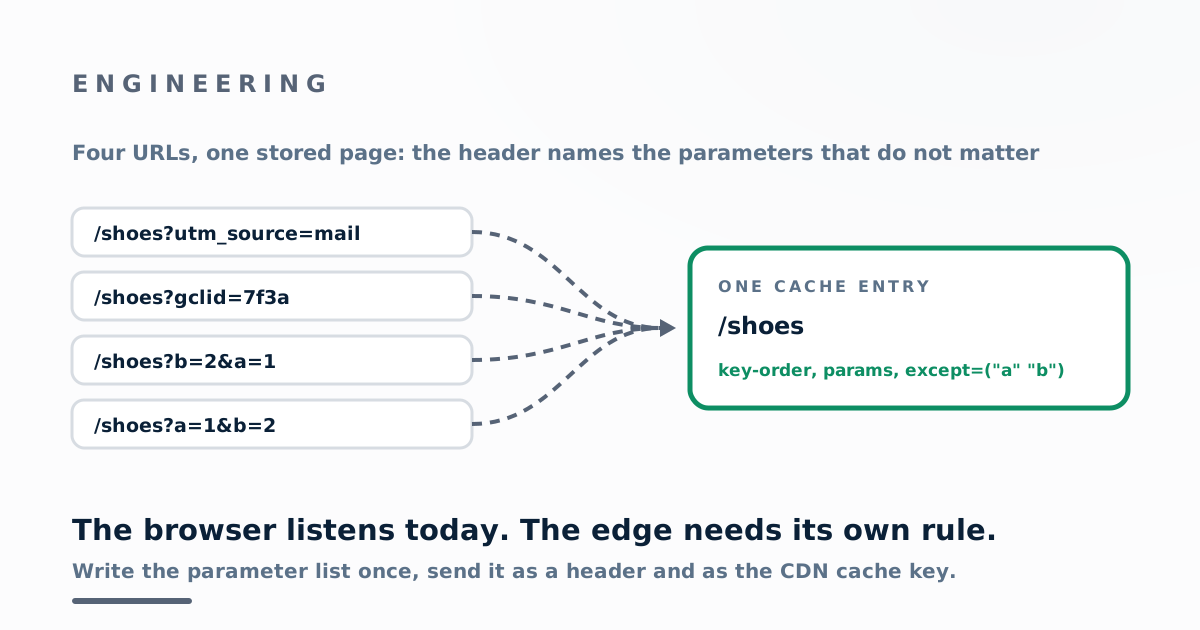
No-Vary-Search on a CDN starts with a response header that tells a cache which query parameters do not change the page, so /shoes?utm_source=mail and /shoes?gclid=x can be served from one stored copy. Today it works in Chromium's prefetch and prerender cache. No major CDN documents honouring it at the edge yet, so the edge still needs its own query-string rule, written to match the header.
The problem it names
A cache key is, by default, the full URL. Every click ID, campaign tag and reordered parameter produces a new key, a new miss and a new trip to origin for bytes the cache already holds. Our piece on Vary and cache keys covers how fast that fragments a hit ratio. Until now the only fix lived inside each cache's configuration. No-Vary-Search moves the knowledge to the origin, which is the one party that actually knows which parameters matter, and lets it say so in a standard way.
The syntax, directive by directive
The field is defined in the IETF HTTP working group's No-Vary-Search draft, still an Internet-Draft in late 2026 and aimed at Proposed Standard. It is a structured dictionary with three pieces:
key-order: two URLs whose parameters differ only in order are the same entry.params=("utm_source" "gclid"): the listed parameters are ignored when matching.params, except=("id" "page"): ignore every parameter except the listed ones. This is the allow-list form, and the safer one for HTML.
They combine: No-Vary-Search: key-order, params, except=("q" "page") says only the search term and page number pick the response, in any order. MDN's reference lists the same forms. The draft also forbids intermediaries from rewriting the field unless they act as the origin, so a CDN passes it through unchanged.
Where it is honoured in 2026
Chromium-based browsers use it from version 121, but only for the navigation prefetch and prerender cache behind the Speculation Rules API. A page prefetched as /shoes is reused when the user lands on /shoes?utm_campaign=autumn, provided the header says utm_campaign is irrelevant. Speculation rules can carry an expects_no_vary_search hint so the browser knows, before the response arrives, whether an in-flight prefetch will fit. If the hint and the real header disagree, the prefetch is thrown away. Firefox and Safari have no confirmed support.
At the edge the picture is thinner. We found no Cloudflare, Fastly, Akamai or CloudFront documentation stating that the header changes their cache key. Treat it as a browser feature for now.
Making the CDN agree with the header
The working pattern is to write the rule twice and keep the two copies identical:
- At origin, send the header on HTML responses whose parameters you understand. Start with
params, except=(...)naming every parameter that selects content. - At the CDN, configure the same list in the query-string part of the cache key. Cloudflare exposes it in Cache Rules, CloudFront in a cache policy (behaviours
none,whitelist,allExcept,all), others under an ignore-query-string option. - Keep tracking parameters reaching analytics. Excluding
gclidfrom the key does not strip it from the URL, so the page and its scripts still see it. - Never ignore cache busters. An ignore-all rule turns
?v=123on assets into a stale file. Scope the rule to HTML.
If the two lists drift, the browser and the CDN disagree about what is the same page: the browser reuses a prefetch the CDN would have answered differently. Generate both from one config file, as the cache-key design guide recommends for every key decision, and test with a URL carrying parameters in reversed order.
Is it worth sending today?
Yes, if you already use speculation rules or plan to: prefetches survive campaign tags, which is exactly the traffic that arrives from ads and email. It costs one header and changes nothing for clients that ignore it. For the edge hit ratio, the CDN rule still does the work, and the header becomes a published statement of it that shared caches can adopt once the draft becomes an RFC.
Want to know how much of your traffic misses the cache because of query strings? The assessment measures it against your logs.