

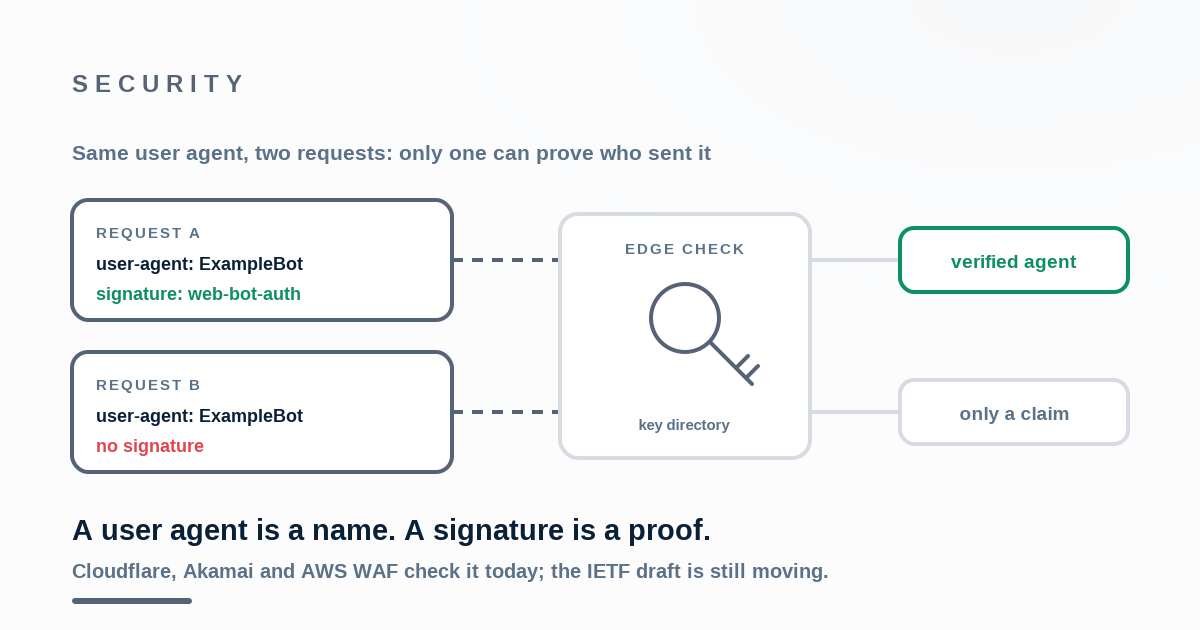
Web Bot Auth on a CDN replaces the guesswork of bot verification with a signature. Instead of trusting a user-agent string or a published list of IP ranges, the bot signs every request with a private key, publishes the matching public key, and the edge checks the signature before deciding what to do. Cloudflare, Akamai and AWS WAF verify it today; the standard behind it is still an IETF draft, and signed traffic is still rare.
Why the old methods are failing
Bots have always announced themselves in the User-Agent header, which anyone can copy. The fix was to check the connecting address against the operator's published IP ranges or a reverse-DNS lookup. That works for a handful of large crawlers, but AI agents now run on shared cloud addresses, browser-automation platforms and customers' own infrastructure, where an IP says nothing about who is driving. Our guide to managing AI crawlers at the edge covers the policy side; Web Bot Auth addresses the identity problem underneath it.
How the signature works
The mechanism reuses HTTP Message Signatures from RFC 9421. Per the working group's protocol draft:
- The bot adds
SignatureandSignature-Inputheaders covering at least the target host and aSignature-Agentheader. Signature-Agentholds an HTTPS address where the operator publishes its keys, as a JSON key set at the well-known pathhttp-message-signatures-directory.- The signature carries the tag
web-bot-auth, a creation time and an expiry, which the draft recommends keeping within 24 hours.
The edge fetches and caches the key directory, verifies the signature, and labels the request. A valid signature proves who signed it, not that the request is fresh: a captured request can be replayed until it expires, so sites with sensitive endpoints can demand a nonce.
Which edges verify it
Cloudflare uses it for verified bots and for a separate signed-agents category whose first members included ChatGPT's agent and browser-automation services; its documentation warns that requests signing components it does not support fail verification. Akamai verifies it in its bot and application-protection products and classifies valid requests as validated bots. AWS WAF Bot Control added it in November 2025, labelling requests verified, invalid, expired or unknown and allowing verified ones by default, which covers sites behind CloudFront. Fastly, as far as its public material shows, still verifies bots by matching the connecting address to the vendor the user agent claims.
A standard still being written
The IETF chartered a Web Bot Auth working group to standardise this, with a milestone of April 2026 for sending a specification to the IESG. That date passed: the group adopted its protocol draft in September and published a second revision in October. Parallel drafts cover a registry of signing agents and anonymous authentication for rate limiting, and the group's own use-case document records disagreement about scope. Expect details to move, and keep vendor libraries current.
What to configure now
Treat a valid signature as a positive signal, never as a free pass. Give verified agents their own rule: allow them where you want AI traffic, rate-limit them like any client, and log the signing agent so you know who is reading. Treat invalid or expired signatures as worse than none, because they suggest tampering. Keep IP verification for crawlers that do not sign yet; one early analysis of AWS logs found no verified signed requests at all. The rest of the tuning lives in our bot management guide.
Want to know which agents are already reading your site, and which ones only claim to? The assessment checks your bot rules against real traffic.