
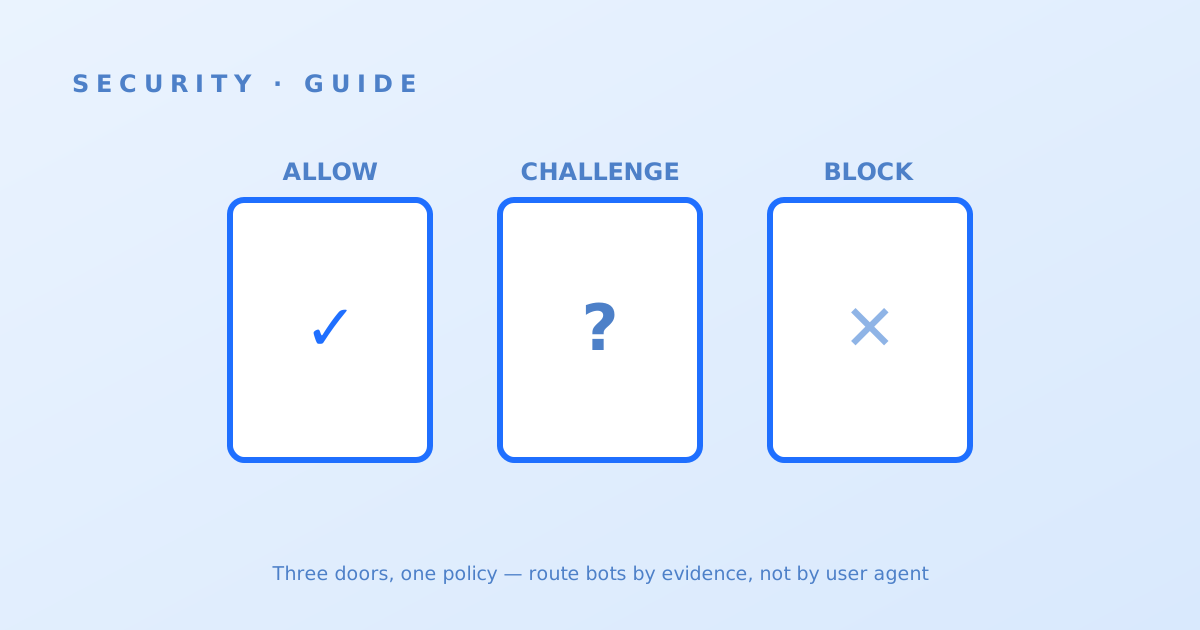
Half your traffic is probably automated, and much of that half is welcome: search crawlers, uptime monitors, payment webhooks, your own mobile app. Bot management is therefore a routing decision, not a wall — three lanes with different consequences, and the craft is in deciding which evidence sends a client down which lane without ever putting Googlebot or your checkout webhook in the wrong one.
Not all bots are the enemy
Start with a census, not a policy. Every bot-management product ships a dashboard that classifies current traffic; run it in observation mode for a week before any rule acts. You are looking for the split between verified crawlers, known-good automation you depend on, obviously hostile patterns (credential testing, inventory scraping, gift-card enumeration) and the ambiguous residue. The proportions differ wildly by business — retailers see scalper bots, publishers see scrapers, SaaS sees credential stuffing — and the census tells you which problem you are configuring for. It also surfaces the automation you forgot you had: internal health checks, partner integrations, the marketing tool that crawls your own site nightly.
The allow lane: verified bots and your own clients
The allow lane is built first because mistakes here are the expensive ones. Major platforms maintain verified-bot lists — crawlers proven by reverse-DNS checks or published IP ranges rather than by their claimed user agent — and you should lean on that verification rather than allowlisting the string “Googlebot”, which any scraper can send. Then add your own legitimate automation explicitly: monitoring probes, partner webhooks, and critically your own native apps, which run no browser JavaScript and can look bot-like to detection heuristics. Where the platform supports it, give first-party clients a cleaner signal than an exception — a mobile SDK integration or a signed request header — so the detector can recognize them positively instead of you carving holes around it.
What detection actually looks at
You do not need vendor-level detail to configure sensibly, but you do need the categories. Modern detection combines network-level fingerprints (properties of the TLS handshake and HTTP behaviour that differ between real browsers and automation frameworks), client-side signals gathered by JavaScript where it can run, and behavioural evidence across requests — pacing, navigation shape, whether a session ever loads assets. Products express the verdict as a score or a category, and your rules act on thresholds. Two consequences matter for configuration: clients that cannot run JavaScript (APIs, apps, feed readers) must be judged on the other signals, so their rules belong on separate hostnames or paths with JS-independent thresholds; and sophisticated operators rotating residential proxies with real browser automation will beat fingerprinting some of the time, which is why the score is a lane-router, not a truth machine. Our bot-management comparison covers how the major products weight these signals differently.
The challenge lane: the ambiguous middle
The middle scores go to challenges, and the default should be the invisible kind: managed and JavaScript challenges that a real browser clears without user interaction, reserving visible puzzles for the rare cases that fail silently first. Challenges are the false-positive safety valve — a shared-IP user or an unusual browser passes in a second, where a block would have cost the session — but they are not free: challenge pages break non-browser clients that strayed into the lane, so alert on challenge rates per path, and treat a spike on an API route as a routing bug, not an attack. Keep challenge thresholds looser on entry pages and tighter on the endpoints your census flagged as abuse targets.
The block lane, and watching for collateral
Reserve outright blocks for high-confidence verdicts and high-cost endpoints — automated traffic on login, payment and scarce-inventory paths — and pair them with rate limits so that whatever slips under the score still cannot run at speed. Then watch for collateral the same way you tuned the WAF: blocked-request counts per path against business funnels, with special attention after every app release, because a new client build can shift fingerprints overnight. Review the lanes quarterly — scraper economics change, verified-bot lists grow, and the AI-crawler wave has made the allow-or-deny decision a business question (do you want to be in training data and answer engines?) as much as a security one. For how the leading engines compare on exactly this tuning surface, see DataDome vs Cloudflare Bot Management.